-.jpg)
|
I saw this poster for sale in an auction and bought it. It describes itself as "an
artist's impression of an electrically hauled express and local electric train in
the new Stafford station". On the left is AL1 E3005 and on the right an AM4
EMU.
E3005 became 81004 and was eventually withdrawn in 1990.
|
|
.jpg)
|
A few months later, a sister poster appeared at auction. This one is "an artist's
impression of an electrically hauled express passing a local electric train between
Liverpool and Crewe". On the right, E3005 makes another appearance and this time the
AM4 can be identified as 006.
Both posters await backing, then framing and they will go up on the wall in
Middelburg. I do think they are absolutely brilliant and will no doubt act as a most
effective even further deterrent to future girlfriends.
|
|
.jpg)
|
This booklet was published by the builders of Class AL1, Associated Electrical
Industries, more commonly known as AEI. This is first in class E3001, later to
become 81001.
|
|
.jpg)
|
E3001 again, not half as impressive in black-and-white.
|
|
.jpg)
|
Technical details; 100 m.p.h. was to remain he top speed on the West Coast for some
time to come.
|
|
|
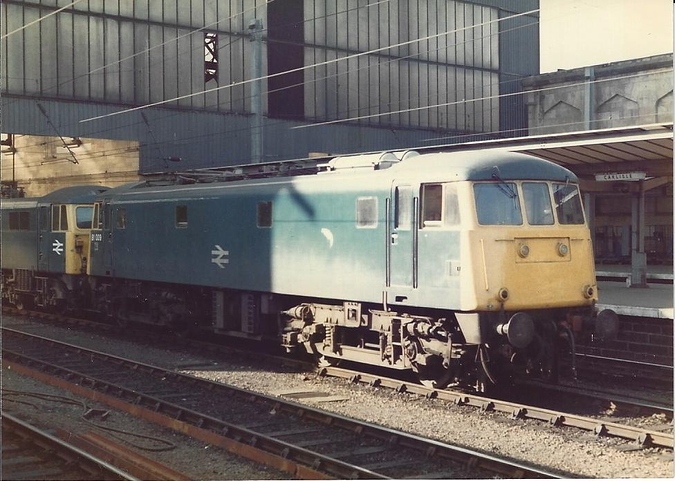
I scoured the photo albums hoping for a picture of either of the above locos - but
no luck. I did find this shot of 81009, formerly E3011, at Carlisle. Date unknown,
possibly in a notebook in a box somewhere.
|
|
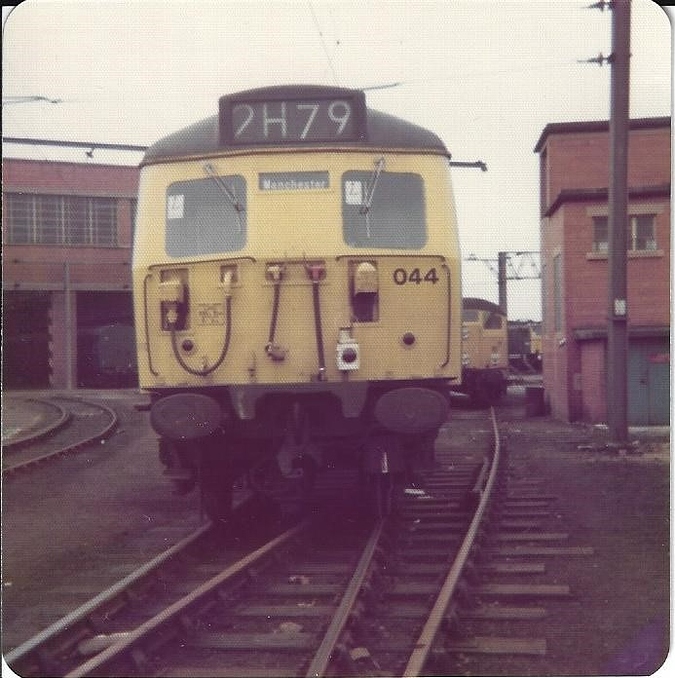
|
I also had a hunt for 006, again to no avail. The earliest photograph I could find
of an AM4/class 304 was this view of 044, captured here away from the 25kv at
Reddish depot in 1976.
|
|
.JPG)
|
This booklet falls into the 'wonderful to have if you can find a copy' category.
Published by British Rail's London Midland Region in September 1960 it commemorates
"the completion of Stage One, Manchester-Crewe, of the Manchester-Liverpool-Euston
Electrification Scheme". The cover is in itself a work of art. Take a closer look.
It depicts the then novel colour light signals, green, double yellow and red aspects
being shown alongside 'feathers' denoting the route set at junctions.
|
|
.JPG)
|
This double page spread is the inside front cover. There is no caption but, after
some staring, it is possible to recognise this as the West end of platforms 13 and
14 at Manchester Piccadilly. The pub in the top right of the picture still exists
and has been the setting for some UIC plotting over the years.
|
|
.JPG)
|
The route map provided clearly shows the pilot stages from Manchester and Liverpool
to Crewe. The big job will follow.
|
|
.JPG)
|
The posters show artists impressions. Here we have photographs of the real thing. On
the left is an AM4. The unit number isn't visible but the car number is M75046. A
quick visit to the bookshelves furnishes that this is unit 002. On the right is AL1,
E3001, slightly older sister to E3005 shown on the posters.
|
|
.JPG)
|
On the left, Manchester Oxford Road. I have a soft spot for this station, having
changed here many times on the way to Holland and, in later years, this was my
destination on the way to school.
On the right, East Didsbury. Many of the components for the stations were
prefabricated.
|
|
.JPG)
|
Another artist's impression, this time of "an electrically hauled express passenger
train passing Wilmslow signal box". This also became a poster but I never liked it
quite as much as the other two. Closer examination while doing this write-up reveals
the reason: A different artist.
|
|
.JPG)
|
"An artist's impression of the new Piccadilly Station, Manchester, now being built".
This is glorious, not least because it looks a lot like Marineville. Anything can
happen in the next half-hour.
|
|
.jpg)
|
Nice artwork is one thing, learning lessons is another. I have owned this book for
many years and it is a must-have should you have any interest in this topic (which
any self-respecting railway/public transport professional should do). Published in
1966, it is hardly a critique as it was commissioned by British Rail London Midland
Region. Instead it is a write-up of the decisions made, challenges and successes.
There is plenty of interesting detail that I will leave you to discover for yourself
but a few highlights for me are:
The project wasn't just about electrification. Network SouthEast coined the term
'Total Route Modernisation'. The West Coast 'electrification' was probably the first
example of this and (sorry about this) was Even Totaller Route Modernisation,
including rationalisation of tracks, re-signalling, bridge reconstruction, station
re-building, new locomotives, new Electric Multiple Units and a whole lot more. The
book covers all of these.
The change of policy to electrify at 25000 volts AC, overriding the fairly recent
decision that the standard would be 1500 volts DC. This was a brave decision and
absolutely the right thing to do. This was, in part, driven by what was going on
over the Channel in France, illustrating the importance of looking outside your
immediate operating environment.
A final observation: Whereas the two posters show an electric locomotive and an
Electric Multiple Unit, the cover illustration of the book shows an electric
locomotive and, to the right, a Diesel Multiple Unit under the wires. The irony
should not be lost. Electrification of individual routes is no substitute for a
programme to electrify the network. I am pretty certain no-one measures the mileage
clocked up by diesel trains under the wires today (and the amount of fuel burned as
a result). Someone should.
|
|
.jpg)
|
This one is for those with an eye for architectural elegance. 'The New Euston
Station 1968' is another London Midland region publication to "mark" (celebrating
success hadn't been invented then) "the complete reconstruction of the first main
line railway terminal to be built in London".
Quoting further: "The brochure is in three chapters. The first gives the history of
Euston and covers also the evolution of the London and Birmingham Railway…". The
second chapter describes the building of the new Euston Station and is illustrated
by photographs showing stages in the progress of the work.". "The third and last
chapter tells exactly what Euston can now provide in the way of services and
amenities for the traveller.".
Rather than photos of the new station, we are treated to a magnificence (a new
collective noun) of artist's impressions.
|
|
.JPG)
|
Main entrance, the view today being obscured by cheap and nasty buildings, and a
cloud of cigarette smoke.
|
|
.jpg)
|
The Concourse.
In the corner, just above the sign for Suburban Tickets was the Area Manager's,
later Ivor's, office. A fantastic view, just pipping the view from the AMO at St
Pancras down the road.
|
|
.jpg)
|
The Grill Room.
I think that is Sean Connery, in role as 007, bottom right.
|
|
.jpg)
|
The Travel Centre.
I got out my magnifying glass (yes, really) to see what the artist had envisaged the
ticket machines might look like. Could those grey shapes be Multiprinters?
|
|
.JPG)
|
Proof was needed and so there was only one place to go to: The ever excellent Modern
Railways. This is very dangerous as there are many diversions in a single volume but
a perusal of 1968 found this article in the December edition.
|
|
.JPG)
|
The artist's impressions have become reality and there, in the bottom left
photograph, is an interior shot of the Travel Centre.
|
|
.JPG)
|
A Multiprinter. A job, not for today, is to see if I have any 1968 Euston-issued
Multiprinter tickets in a box somewhere.
|
|
.JPG)
|
I also checked The Railway Magazine. Their December 1968 edition trumps Modern
Railways with a photograph of certainly four, maybe five, Multiprinters. Look
closely and you will also see that each window has a Handiprinter. This
Multiprinter/Handiprinter combination was still going strong in the Booking Office
at Nottingham when I started there.
|
|
.jpg)
|
It wasn't until the mid-1970s that electrification north of Weaver Junction to
Glasgow was completed. The gap (in the timescale and the wires) was (don't fall off
your chair) caused by Government dithering. Cleverly marketed as the Electric Scots,
this was the cover of the October 1974 Railway magazine.
|
|
.JPG)
|
I was certain that I still had this badge somewhere. Having spent several hours
going through boxes upstairs and finally giving up, I noticed my InterCity Senior
Conductor's bag propping the door open five paces from where I am sitting. Sure
enough...
|
|
.JPG)
|
A week after I had originally posted this page, I stumbled across this 1974-1975
Inter-City Electric Scots timetable. The contents are essentially an extract of the
full passenger timetable, specifically table 65. I've kept this on my desk and will
have a proper look through it when time allows, possibly carrying out a few then and
now comparisons. One of the things that jumped out at me was that, despite this
being the West Coast timetable (i.e. from London Euston), the two London St Pancras
to Glasgow services are shown. Watch this space.
|
|
.jpg)
|
This page is meant to be about electrification of what we now call the West Coast
Main Line at 25kv AC but I should probably mention the Lancaster - Morecambe -
Heysham electrification, this booklet being produced by the Railway Executive in
September 1953. This qualifies because Lancaster will have to wait until the
mid-1970s before seeing any more wires.
|
|
.jpg)
.jpg)
|
I will reproduce this page in full, partly because this illustrates (1) real
innovation (as opposed to today's version), (2) testing and piloting, (3)
cooperation and (4) getting things done quickly.
The first electrification of the British Railways (London Midland Region),
Lancaster-Morecambe-Heysham line (Figure 1) was made in 1908 by the former Midland
Railway to test the use of single phase 6.6 kV 50 cycle system for electric
traction. The experimental re-equipment at 6.6 kV 50 cycle, with improved
performance, has been carried out under the direction of Mr. R. A. Riddles, Member
of the Railway Executive for mechanical and Electrical Engineering, in association
with Mr. J. C. L. Train, the Member for Civil and Signal & Telecommunications
Engineering. Messrs. British Insulated Callender's Cables Limited, The English
Electric Company Limited, also the British Electricity Authority, have co-operated
in the experiment. Trial running commenced in November, 1952 (less than a year from
the initiation of the scheme) and regular public services in August, 1953. The
intervening period was used for trials, including tests to determine the effect on
the power supply and for modifications to ne made to the telecommunication and
signalling system found necessary as a result of the trials.
|
|
.jpg)
|
Using a similar line of logic, Manchester London Road/Piccadilly also received wires
before the West Coast electrification, this being the 1500v DC electrification of
the Manchester, Sheffield and Wath lines. This is a booklet published by the Eastern
and London Midland regions to commemorate the inauguration of the scheme on 14
September 1954. Work had started years earlier but was put on hold due to the war.
|
|
.jpg)
|
The primary objective of this electrification was to improve the movement of coal
traffic from the Yorkshire coal fields to the Lancashire power stations. The
gradient map clearly shows the long slog up to the summit culminating with the
Woodhead Tunnel, more than 3 miles in length. It is written that, prior to
electrification, steam locomotive footplate crews would have to crouch down at floor
level, gasping for breath in the smoke-filled tunnel.
|
|
.jpg)
|
Two classes of loco were built, EM1 primarily for freight and a smaller number of
EM2, primarily for express passenger services between Manchester and Sheffield
Victoria.
A prototype locomotive was under construction at the start of the war. With no main
line to run on upon cessation of hostilities, it was loaned to the Netherlands
Railways (also operating at 1500v DC) to help with an acute shortage of motive
power. Between 1947 and 1951 it ran over 300 000 miles and earned the nickname
'Tommy'.
|
|
.jpg)
|
The top photograph shows EM2 no. 27000. With the controversial, some might say
stupid, decision to run down and then close the Woodhead route, 27000 and her six
sisters were sold to the Netherlands Railways in late 1969. 27005 was broken up for
spares but the remainder of the class did sterling work until the mid-1980s.
|
|
.JPG)
|
I happened to see 1501, formerly 27003, in the Railway Museum at Utrecht last week.
|
|
|
|
.jpg)
|
Postscript. As I was about to send all this off for uploading to the website (thank
you Darnis), I had a final thought. With the wonderful benefit of hindsight, what
would be the one thing I would have done differently? For me, this is an easy
question to answer. I would have made platforms 13 and 14 at Manchester Piccadilly
two island platforms, 13, 14, 15 and 16, two Up, two Down - and the same at Oxford
Road. Until this comes to pass the current problems of "congestion" on what has
become known as the Castlefield Corridor will not be resolved. Clever schemes past
and planned are not going to make any significant difference.
|
|
|
Apologies to Third Rail enthusiasts.
|
 Go to UK site
 You're currently here
.jpg)
.jpg)
.jpg)
.jpg)
.jpg)
.JPG)